
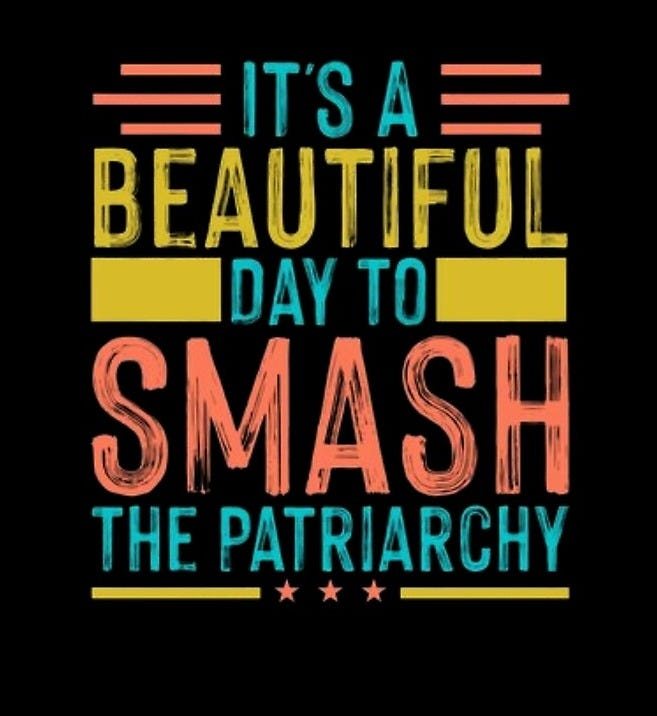
Your Support of Patriarchal Manipulation Is What’s Hard to Understand
One thing I’ve found over the years of serving as a spiritual teacher and author is that there is nothing that gets the panties of those involved in the leadership of institutional religion twisted into knots faster than confronting them with historical facts, scrutiny and a challenge to their (conscious or unconscious) hypocrisy.
Recently, I had the privilege of ordaining a person who had been one of my students for the past five or six years, into the priesthood of a Queer-centric, post-denominational, classically gnostic (not Gnostic) spiritual community, where they will serve as a caretaker, steward and mentor to those seeking a deeper understanding of the teachings of the Great Spiritual Revolutionaries of the aeons. That community, of which I have previously written, exists as it has since the early 1980s, as an esoteric expression of pre-institutional “Catholic” mysticism (similar to the spiritual practices of the Desert Skete).
In the days and weeks that followed that ordination, a number of thinly-disguised, passive aggressive “inquiries” came in from individuals, whose behind-the-scenes machinations and attempts to call into question the validity of that ordination were, in equal parts, both laughable and tragic.
They demonstrated an allegiance to a manipulative, male-dominated mythology, created by a patriarchal institutional church, which itself has been unable to clearly document its own “apostolic succession” prior to Scipione (Fabrizi) Rebiba in the 14th century of the Common Era.
Was I supposed to make a public proclamation that on a certain date, having met the imaginary and arbitrary “requisites” of someone else’s jurisdiction, I was going to ordain someone of my choosing to provide sacramental witness to their personal spiritual calling? And if someone were to disagree, was I supposed to simply call it off?
For more than forty years, I tried tirelessly to reform the institutional church from within. Calling out its long history of racism, sexism, homophobia and intolerance, I challenged people of marginalised communities to ask themselves why they would want to be ordained into a church that was little more than an oppressive, manipulative and xenophobic body, created in (or spun-off from) an emperor’s decreed state religion in the fourth century of the Common Era.
When I felt that my challenges and calls for reform and recognition of the patently false origin stories of that original institution (and as such, all of the later Protestant and reformed spin-off churches that would follow, including the Old Catholic and so-called “independent Catholic” churches of the 11th through 20th centuries) were falling upon deaf ears, I walked away. Publicly. With integrity and purpose. And unapologetically.
And it wasn’t, for me, a difficult choice.
With a doctoral degree in theological anthropology and advanced academic background against which most “ministers’” training would pale by comparison, I never felt it necessary to impress others with my comprehension of the ancient Aramaic, Greek or Latin texts upon which the institutional churches were based. I didn’t consider my job to teach religion. I considered it a role in which I was entrusted with the spiritual care and nurturing of those who were ultimately on a journey toward self-empowerment and wholeness — something no religion could ever impart.
My experience with those in the world of institutional churches was no different than my experience over the past 25 years with the practitioners, authors and “scholars” of the 20th century neo-pagan and pop-culture witchcraft movements, new age spirituality and pop-culture esotericism.
My attitude has been, and I suspect will always be that one should practice whatever it is that brings them comfort, challenge, empowerment and purpose — whether than is religion, esotericism, mysticism or humanism. But I will always draw the line when it comes to appropriation of other traditions and cultures, wrapped in the lies of “origin stories”.
Just as the Catholic church was not founded by any of the “Apostles” (mostly because the entire mythos of the Christian and Jewish scriptures are simply that — mythos!), neither was any of what Gerald Gardner (or Charles Leland before him) rooted in Italian, Tuscan, Etruscan or Sicilian esotericism. Period.
Of course, just as the “leadership” of many churches are afraid to discuss that topic with me, because they know I will point out that the records of Apostolic Succession (including my own) are a spiritual mythology… an ancient tradition meant to inspire confidence, not power over anyone. Similarly, I would point out to the many authors of pop-culture witchcraft that Leland lied and made up his “Gospel of Aradia”, just as people like Gerald Gardner, Doreen Valiente, Raven Grimassi, Alex Sanders and Lori Bruno made up their own “origin stories” (a fact that my uncle, Leo Martello pointed out to Margot Adler about his own origin stories… and those of Sanders, Gardner, Herman Slater, et al, many years ago). But none of them want to have that conversation either.
Primitive religious mythologies likely served primitive cultures well to some extent. But it’s absurd, in my personal and professional opinion, to adhere to primitive notions, superstitions, and manipulative tales of such ancient mythologies in the 21st century.
Bread and wine don’t become flesh and blood. “Original Sin” didn’t exist. There was no Garden of Eden. The Jesus story was written in the second and third centuries of the Common Era, based on plagiarised texts from other cultures and mythologies.
Drawing a circle on the ground with certain incantations neither protects you nor binds others from affecting you. Neither does drawing a pentagram in the air, sticking a crystal up your ass, or dancing about naked under the moon (although the latter can be quite freeing, and I highly recommend it… especially if you’re hung… send me the video!)
I serve as the Spiritual Director of an intentional community that draws deeply on the gnostic teachings of many traditions, not on religion. I will continue to ordain those who ask me to do so, as they are properly trained and demonstrate the skills necessary to perform their role, because service to that community compels me to honour their spiritual calling — not judge whether I think they are worthy.
And those who take issue with that can certainly do so, while sparing me their opinions, of which I have not the slightest interest. If necessary, I am happy to translate that into languages they might feel more comfortable with:
- Et qui actiones meas ecclesiasticas impugnant, id certe facere possunt, dum mihi suas opiniones, quarum minime interest, parcant.
- Και όσοι διαφωνούν με τις εκκλησιαστικές μου ενέργειες μπορούν σίγουρα να το κάνουν, χωρίς να μου εκφράσουν τις απόψεις τους, για τις οποίες δεν έχω το παραμικρό ενδιαφέρον.
- ويمكن لأولئك الذين يعترضون على أفعالي الكنسية أن يفعلوا ذلك بالتأكيد، دون أن يتدخلوا في آرائهم، التي لا أهتم بها على الإطلاق.
- E chiḍḍi ca pigghianu prubblemi cchî me azzioni ecclisiàstichi ponnu di sicuru farilu, risparmiannumi li sò upiniuni, ca non mi ntirissanu lu minimu.
