
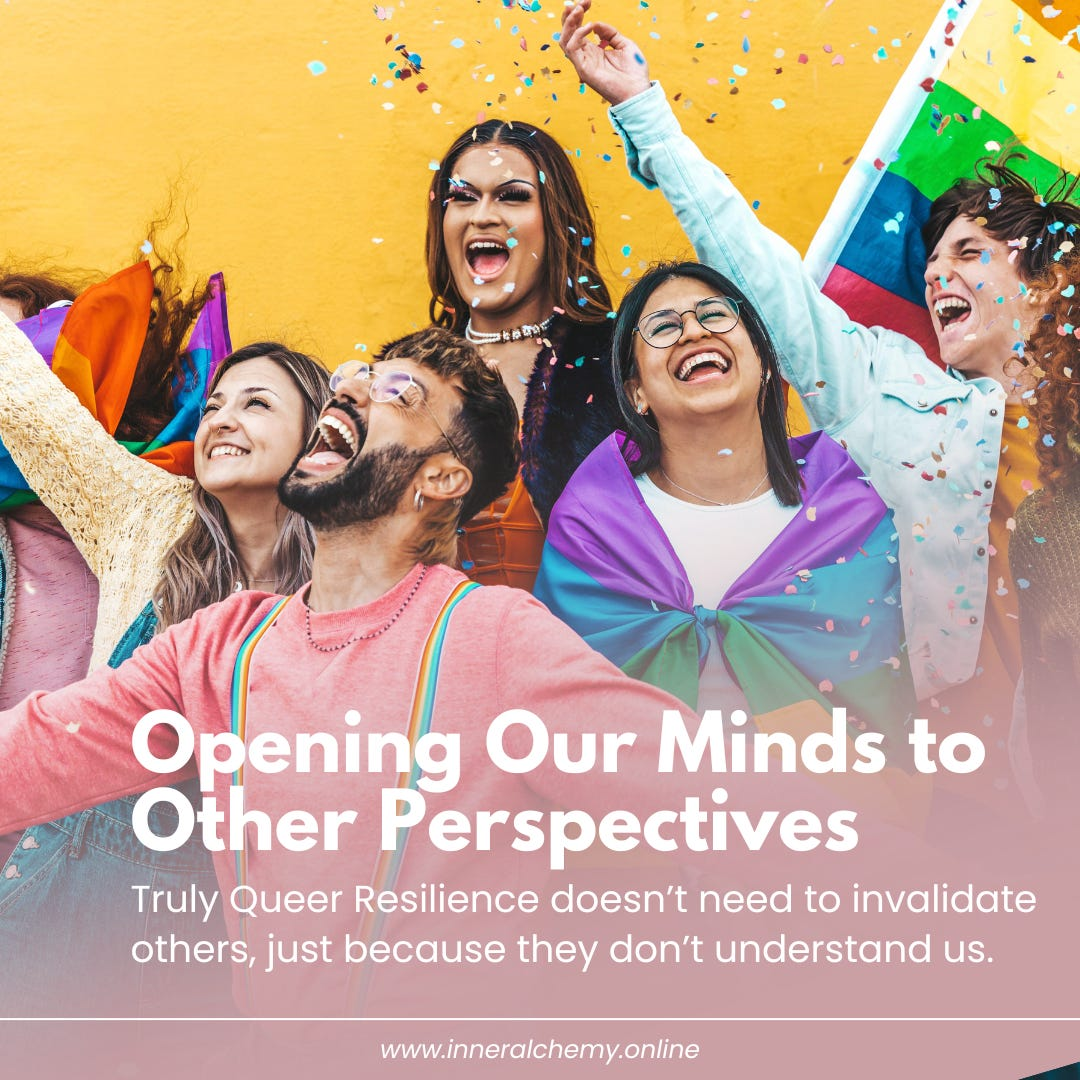
Truly-Queer Resilience doesn’t need to invalidate others, just because they don’t understand us
Writing in an article on the Queer AF website, Freddy McConnell recently noted of the impact the anti-trans ruling by the UK’s Supreme Court:
“Our lives are this queasy clash of realities: the normalcy of our everyday vs the waking nightmare of staring, powerless, as media, public bodies, governments and the courts succumb, over eight creeping years, to the manipulation of anti-trans ideologues and the moral panic they put in motion.”
(That publication, by the way, is doing some vital work, particularly on behalf of the trans community, so I encourage you to check them out and show them how much we appreciate them.)

Just a few days from the start of LGBTQ+ Pride Month, I’ve found myself wondering what more we can do to protect one another, increase visibility and advocate for ourselves in ways that not only make better the lives of the privileged class of our community, but which address the inequities we cause within that community ourselves.
Pride celebrations tend to reflect something of a snapshot of where a particular geographical community exists in terms of its culture, its lived experiences and its challenges — internally and within the larger community, city or region. And quite often, representation of all of the letters of the LGBTQ+ “alphabet mafia” falls short in those celebrations.
In my professional work within the community, bisexual and non-binary people, asexual and intersex people frequently tell me that they don’t always feel welcome — not just at Pride, but in local Queer businesses and community organisations. And I am beginning to see this happen in other ways, more broadly.
Recently, I witnessed a group of extremely vocal Queer atheists go on a psychotic revenge tour, attacking a podcaster for having on his show an academic whose personal and political views lean heavily right. The podcast was about mythology, and the topics being discussed had nothing to do with politics, Queer inclusion or gender equity. And while my personal disdain for this guest is well known, so too is my respect for his scholarship in the field of deconstructing the Judeo-Christian mythologies from an exegetical and anthropological perspective.
Now, within the pop-culture Queer atheist community, there are several self-styled “leaders” who are little more than ill-informed, self-aggrandising provocateurs. And sadly, the majority of them are what I would consider “militant trans activists”. Setting aside the absolute certainty that the brash, boundary-pushing and in-your-face facade these individuals portray comes from a place of having experienced deep personal trauma — often violent emotionally or physically — there is a distinction between their way of moving through life and many of the Queer atheists, non-theists and secular humanists with whom I have worked throughout my adult life.
First is the display of anger for anger’s sake that many of those who were wounded by religious institutions, but who have either not sought out professional support or who lack emotional maturity display as a trauma response in the atheist community. We see this in those who feel compelled to create an “atheist movement”, which strikes me as being bizarre, since their movements often look very much like a religion to me.
Then there is the Queer component, in which the struggles and feelings of marginalisation, discrimination and abuse manifest as a need to create drama in much the same way that Charles Shultz’ Pigpen creates that cyclone of chaotic filth wherever he goes. We all know the type, and if you don’t, well… you might be the type.
These are the same people who proclaim that bisexual people are “just not willing to admit they’re gay,” or that asexual people don’t belong in the LGBTQ+ community because they’re asexual. (?!?)
Now don’t misread me. I am all about activism, protest and effective messaging, even when it needs to be confrontational. I have been at the forefront of AIDS activism, as a member of ACT-up, GMHC and CENTAUR. I have fought on the frontlines of the Radical Faery, Queer Resistance and other LGBTQ+ fights. And I am among the most vocal advocates of consigning religion to the trash-heap of history as a manipulative, dangerous and violent societal ill.
This is not that.
This is more about a group of people — a cult really — setting out to destroy, cancel and bring serious harm to anyone who dares try to engage in responsible and respectful dialogue with them over differences in perspective.
And I have been on the receiving end of their ire.
If we’re going to advance our place in society… If we’re going to get the equity and security that should be our birthright to be who we are, then we’re going to have to grow up and ensure that every time one of these militant cults attacks someone unfairly, we show up for their “victims” and call them out.
Not every ally fully “gets it”. Some of them don’t understand why we, in the fields of mental health, endocrinology and sociology encourage parents to let their children blur the lines of gender-conforming roles when they are young. It’s not about “turning kids trans” because there is no such thing. It’s about allowing them to grow up in a world where they can be who they are.
Not every ally gets, for example, that I am genderqueer because I wholesale reject the existence of binary genders — not because I want to be a different gender than the one assigned at birth — but because I believe my chromosomal make-up indicates my sex, not my gender. And I don’t believe that anyone is entirely masculine/male or feminine/female. Some of my allies imagine that because (among the many characters I have portrayed on stage) I have done drag, it must mean I am trans and want to be a woman, or at the very least am gender-fluid. But I am not.
I have experienced discrimination from the straight world and from the Queer world. I have been marginalised by the religious and by the secular.
But I recognise that some of my most beloved professors in college were at the absolute opposite end of the ideological spectrum when it came to politics, LGBTQ+ rights, women’s rights, and racism from me. That didn’t make them any less effective at teaching anthropology or maths. And when, for example, they were teaching history, psychology or literature and their biases showed, I could bring that up and debate with them.
Our community has been beaten down, yes. And not all have had the benefit of my privileged Afro-Sicilian education, culture and experience. But intellectual curiosity and the desire to be seen and heard is a universal trait that can be accessed by any of us.
Our resilience… our ability to reclaim our places in this society do not require us to invalidate others, simply because they can’t see things from our perspective. If I am sitting on the piedmont, overlooking the valley below, my view will be radically different from the person in the valley trying to look up. By reaching down and helping them get to where I am, we can share that perspective. We might still not agree upon what it is we see, but we will have made progress.
That’s my hope for this Pride Month. While we refuse to be canceled, let’s also refuse to cancel others without first trying to engage them. Simply because someone doesn’t understand me doesn’t mean I fully understand them either.
And if there is not room in our Pride celebrations for bisexual, intersex, trans, asexual, questioning and queer adjacent folk… for people of all cultures, religions, ethnicities and backgrounds… then maybe it’s time we asked ourselves if we’re not becoming a little too much like the narrow-minded, right-wing fascists and less like the Queer ancestors who fought for our rights that we are trying to preserve today.